
Pelaksanaan Badal Haji: Isu Kontemporari dan Penyelesaian Berasaskan Maqasid al-Shariah
Demographic Factors of Zakat Payers Using Bibliometric and Empirical Analysis
Author
Noraini Saro
Faculty Education & Humanities, UNITAR International University, Kelana Jaya,Malaysia
Raihan Nasir
Faculty of Economics and Muamalat, Universiti Sains Islam Malaysia, 71800 Nilai , Malaysia
Nuralia Jamila Ali
Universiti Kuala Lumpur Business School, 50250 Wilayah Persekutuan Kuala Lumpur, Malaysia
Siti Raudah Abdul Karim
Academy Contemporary Islamic Studies, (ACIS) UITM Shah Alam, 40450 Selangor, Malaysia

Abstract :
This study investigates the influence of demographic factors age, gender, education level, and employment type on the acceptance and continued use of digital zakat applications in Malaysia. With growing digital transformation in Islamic financial services, understanding user behavior is crucial for improving zakat platform adoption. Grounded in the Expectation-Confirmation Theory of Continuance and the Unified Theory of Acceptance and Use of Technology (UTAUT). Using a quantitative research design, data were collected from 405 respondents and analysed through One-Way ANOVA to evaluate the impact of age, education level, and employment type on two dependent variables: user acceptance and intention to continue usage. The results show that age and employment type significantly influence both acceptance (F(4, 400) = 5.208, p < .001; F(3, 401) = 6.118, p < .001) and continuance intention (F(4, 400) = 4.313, p = .002; F(3, 401) = 5.442, p = .001). In contrast, education level was not a significant predictor of either variable. These findings align with UTAUT constructs such as effort expectancy and facilitating conditions, which may vary more with age and job experience than formal education. Younger users and civil servants were more inclined toward adopting digital zakat platforms due to greater digital literacy and occupational exposure. In parallel, a bibliometric analysis of zakat-related literature (2018–2022) showed a shift from traditional Islamic themes to contemporary issues like digital zakat, behavioral intention, and social influence. These insights highlight the convergence of digital behavior and Islamic financial practice, underscoring the importance of user-friendly application design and inclusive outreach strategies. The study advocates for interdisciplinary approaches combining Shariah principles, behavioral science, and technology to ensure sustainable and inclusive zakat systems aligned with the objectives of Maqasid Shariah and the Sustainable Development Goals (SDGs).


Journal Specification
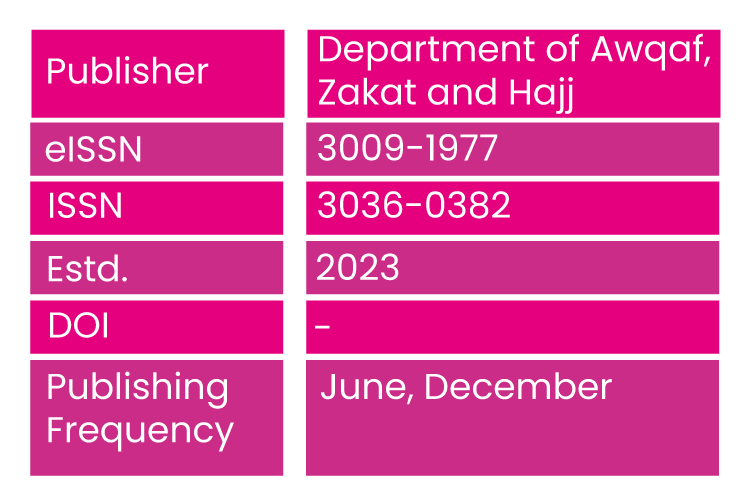
The Journal of Awqaf, Zakat, and Hajj (Jawhar) is registered in MyJurnal, an online system by the Citation and Infometric Division, the Higher Education Department, MoHE. MyJurnal indexes Malaysian journals and provides bibliographic data and full-text articles across various disciplines, including Arts & Humanities, Engineering & Technology, Medical & Health Sciences, Sciences and Social Sciences.