
Ethics And Malpractise
1. Publication Ethics
Frequency Of Publication
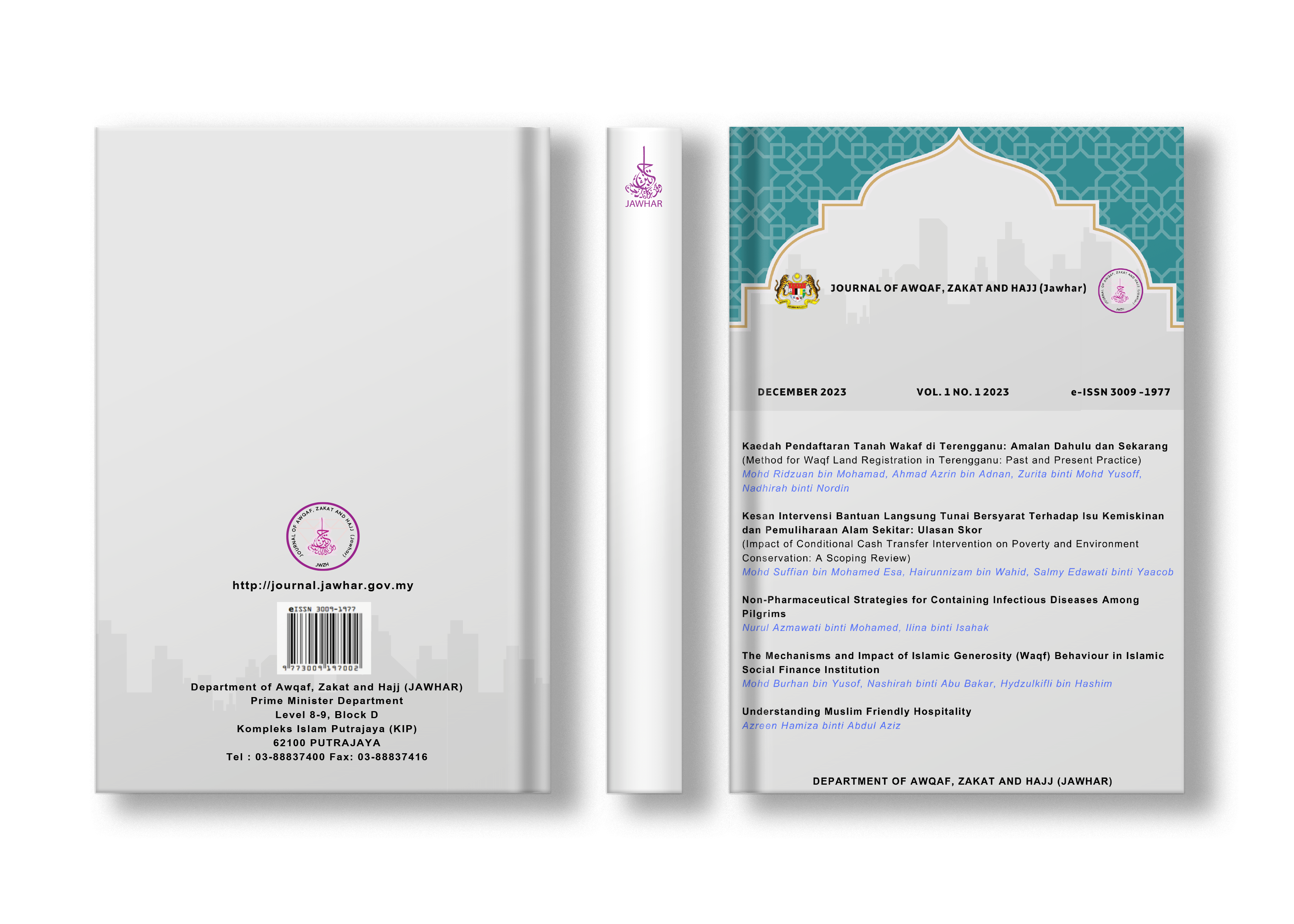
This journal publication are in June and December. The unpublished journal articles that are still under review will be published for the next issue.
Ethics Statement
(i) This is the statement of publication ethics for Journal of Awqaf, Zakat and Hajj published by The Department of Awqaf, Zakat and Hajj (JAWHAR). The Journal of Awqaf, Zakat and Hajj (Jawhar) are committed to upholding the highest standards of publication ethics, academic integrity, and scholarly rigor. As an international, double-blind peer-reviewed journal specialising in the administration of awqaf, zakat, hajj and umrah as well as the Malaysia Public Administration which covers but not limited to the following topics such as policy development, strategic policy, human resource management, policy implementation, monitoring and evaluation. The journal relies on the collective efforts of authors, reviewers, editorial board members, and publishers to maintain an ethical publication ecosystem.
(ii) The principles outlined in this comprehensive statement are adapted from the Committee on Publication Ethics (COPE) Best Practice Guidelines, the MyCite Selection Criteria, Elsevier Ethical Policies, and relevant national and international academic standards. The prevention of publication malpractice is a central obligation of the Editorial Board. Any form of unethical publishing behaviour including plagiarism, data fabrication, citation manipulation, or redundant submission is strictly prohibited
2. Responsibilities of Authors
(i) Authors submitting original research to Jawhar must adhere to ethical requirements across all stages of manuscript development, submission, and post-publication.
(a) Reporting Standards & Academic Honesty: Authors must present an accurate, objective, and unbiased account of the research conducted. The underlying empirical data, theoretical formulations, or legal derivations must be represented truthfully without fudging, fabrication, or selective omission of conflicting evidence. Intentional inaccuracies or fraudulent statements constitute grave ethical violations.
- Data Access, Sharing, and Retention: Authors may be requested to provide raw data or supplementary files associated with their manuscript for editorial review. Authors are expected to retain raw research data for a reasonable duration following publication and make it accessible where feasible, aligned with standard data statements (such as Sherpa Romeo and ALPSP-STM guidelines).
- Originality and Avoidance of Plagiarism: Manuscripts submitted to Jawhar must be entirely original works. Plagiarism in any form including verbatim copying, paraphrasing substantial portions of another author’s work without attribution, or claiming another researcher’s results is completely unacceptable.
- Self-Plagiarism & Text Recycling: Authors must avoid self-plagiarism, which includes reusing significant passages of their own previously published text, figures, or ideas without explicit citation and justification.
- Multiple, Redundant, or Concurrent Submissions: Authors must not submit manuscripts describing essentially the same research to more than one journal concurrently. Submitting a paper simultaneously to multiple organisations or institutions by submitting work that is already published or under review elsewhere, constitutes unethical conduct. A manuscript rejected by another journal may be submitted only after formal rejection or official withdrawal from the previous publisher.
- Authorship and Credit: Authorship must be limited exclusively to individuals who made a significant contribution to the conception, design, execution, or theoretical interpretation of the reported study.
- Co-Authors: All individuals who made substantial contributions must be listed as co-authors.
- Contributors: Individuals who assisted in specific non-authorial capacities (e.g., proofreading, administrative support, basic technical assistance) should be acknowledged in an Acknowledgments section.
- Corresponding Author Responsibilities: The designated corresponding author is responsible for ensuring all appropriate co-authors are included, no inappropriate co-authors (“ghost” or “gift” authors) are listed, and all co-authors have reviewed, approved, and consented to the final submission.
- Disclosure of Conflicts of Interest: Authors must disclose any financial, personal, commercial, or academic conflicts of interest that could be perceived as improperly influencing the findings or interpretation of their work. All external sources of funding and research grants must be fully disclosed in the manuscript.
- Human Subjects Ethics: Studies involving human participants (e.g., surveys, interviews, case studies regarding zakat distributions or hajj management) must comply with international standards such as the Declaration of Helsinki or the Belmont Report. Authors must obtain prior Institutional Review Board (IRB) or Ethics Committee approval, report the reference number, and ensure informed consent was obtained from all participants. Participant privacy, confidentiality, and dignity must be strictly safeguarded.
- Fundamental Errors in Published Works: If an author discovers a significant error, calculation mistake, or inaccuracy in their published paper or manuscript under review, they are obligated to immediately notify the Chief Editor and collaborate to issue a formal correction or retraction.
- Change of Authorship – once the Journal accepts a manuscript for publication, amendments in the authorship in the form of addition, deletion or rearranging the order of the names are no longer allowed. However, changes in the authorship (addition, deletion or rearrangement) can be made during the review process before a manuscript is accepted.
- The affiliation for each Author should be the institution where much of the work was performed. If an Author has subsequently transferred to another institution, the new address may also be included in the manuscript.
- Responsibilities of Editors
- Editors should ensure the integrity of the publication review process. As such, editors should not reveal either the identity of authors of manuscripts to the reviewers or the identity of reviewers to authors.
- Editors must ensure that all the information related to submitted manuscripts is kept as confidential before publishing.
- Actively seek the views of board members, reviewers and authors on how to improve/increase the image and visibility of the journal.
- Give clear instructions to potential contributors on the submission process and what is expected of the authors.
- Ensure appropriate reviewers are selected/ identified for the reviewing process
- Responsibilities of Editorial Advisory Board
- The Editorial Advisory Board is responsible for deciding which of the submitted articles should be published.
- The Editorial Advisory Board must ensure that information regarding manuscripts submitted by the authors is kept confidential.
- The Editorial Advisory Board is accountable for everything published in the journal; thus, it has complete responsibility and authority to reject/accept an article. However, the published manuscript would not represent the stand or opinion of the Editorial Advisory Board and the Editorial Team of Journal of Awqaf, Zakat and Hajj (Jawhar).
- The Editorial Advisory Board should take reasonably responsive measures when ethical complaints have been presented concerning a submitted manuscript or published paper. They shall instruct a proper and fair investigation into ethical complaints.
- Responsibilities of Peer Reviewers
Peer reviewers play a critical role in maintaining academic standards through objective, expert evaluation. JAWHAR operates a strict double-blind peer-review model to ensure impartial decision-making.
- Contribution to Decisions: Reviewers assist the Chief Editor in making informed editorial choices and provide constructive feedback to help authors improve their work.
- Promptness & Reciprocity: Appointed reviewers who feel unqualified to assess a submission or know they cannot meet the review timeline (typically 4 weeks) must inform the editor promptly and decline the invitation so another expert can be selected.
- Standards of Objectivity: Reviews must be conducted with absolute Personal criticism or derogatory remarks toward the authors are strictly inappropriate. Reviewers must support their evaluations with clear arguments and academic evidence.
- Confidentiality: Manuscripts received for review must be treated as privileged, confidential documents. Reviewers must not discuss, quote, share, or distribute any part of an unedited manuscript with third parties without prior authorization from the Chief Editor.
- Disclosure & Conflict of Interest: Reviewers must disclose any competing financial, institutional, collaborative, or personal relationships with the authors or institutions linked to the paper and decline reviewing if a conflict exists. Reviewers must not use un- published materials or insights gained during review for personal gain.
- Acknowledgment of Sources: Reviewers should identify relevant published work that has not been cited by the authors. Any claim that an observation, argument, or derivation has been previously reported must be accompanied by a citation. Reviewers must also notify the editor immediately if they detect substantial similarities or overlaps between the manuscript under evaluation and any other published
- Double-Blind Peer-Review
- The Journal follows a double-blind peer-review process, whereby the Authors do not know reviewers and vice versa. Peer review is fundamental to the scientific publication process and the dissemination of knowledge. Peer reviewers are experts chosen by the Editor-in-Chief to provide assessment of a written research manuscript, with the aim of improving the reporting of research and identifying the most appropriate and highest quality material for Jawhar.
- Regular reviewers selected for Jawhar should meet minimum standards regarding their background in the research field, publication of articles and formal training
- Reviewers are experts in the scientific topic addressed in the manuscripts they review and are selected for their objectivity and scientific knowledge. Individuals who have a major competing interest in the subject of the manuscript are not appointed as reviewers for such manuscript.
- Post-Publication Corrections, Retractions, and Sanctions – when errors or misconduct are identified following publication, Jawhar follows formal protocols to uphold the permanent legal and academic record.
(i) Categories of Post-Publication Amendments:
- Erratum: A notification of a significant administrative or technical error introduced by the journal during production that affects the scientific integrity or clarity of the article.
- Corrigendum: A notice of a significant error made by the author(s) that n impacts the scientific or legal accuracy of the All co-authors must sign approved corrigenda.
- Retraction: A formal notice invalidating a published paper due to major errors, unrecoverable technical flaws, or ethical violations (e.g., plagiarism , redundant submission, fraudulent data). Retractions are published after an investigation by the Chief Editor and Editorial Advisory Board.
- Addendum: An official note providing additional relevant details or clarifications to a previously published article, often in response to reader queries.
- Penalties and Sanctions for Misconduct: If the Editorial Advisory Board confirms an author, reviewer, or editor has committed scientific misconduct (e.g., plagiarism, data falsification, or unauthorised use of data), one or more of the following actions will be enforced:
- Immediate rejection of the manuscript under consideration.
- Formal retraction of published work with a published public notice.
- Formal ban prohibiting the offending author(s) from submitting work to Jawhar for a period ranging from 1 to 3 years.
- Official notification n sent to the author’s home institution or governing ethics body.
- Dismissal of any Editorial Board member or reviewer found guilty of unethical behaviour or breach of confidentiality.
Journal Specification
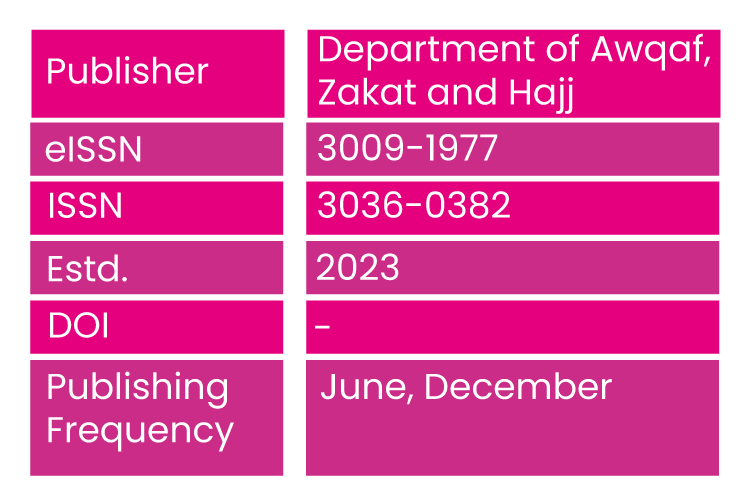
The Journal of Awqaf, Zakat, and Hajj (Jawhar) is registered in MyJurnal, an online system by the Citation and Infometric Division, the Higher Education Department, MoHE. MyJurnal indexes Malaysian journals and provides bibliographic data and full-text articles across various disciplines, including Arts & Humanities, Engineering & Technology, Medical & Health Sciences, Sciences and Social Sciences.