
Digitalisation of the Online Zakat Majlis Agama Islam Negeri Pulau Pinang (MAINPP): TOE Framework
Zurri Waqf In Malaysia: Syariah Rulings, Implementation Reality, And Future Commercialization
Author
Samsudin Wahab
Institut Pemikiran dan Kepimpinan Melayu (IMPAK)
Universiti Teknologi MARA
Mohamad Kairi Ghazali
Zakat Pulau Pinang
Alwi Ahmad
Zakat Pulau Pinang
Mohd Asyraf Abd Wahab
Zakat Pulau Pinang

DOI : https://doi.org/10.65404/JAWHAR.302007
Keywords : digitalisation, zakat, collection, electronic payment, online transaction
Abstract : The Industrial Revolution 4.0 has contributed to the increasing use of ICT tools in business transactions in the service and product sales sector. The result of various official online applications and unofficial social media platforms contribute to payment and claims either from or to customers. Human and machine interaction has become important, especially in complying with Zakat payments by Muslims in Malaysia. Therefore, it is important for financial institutions to enhance their online services in order to comply with government policy in harmonizing the usage of applications. Digitization means adaptation of a system, process, etc. to be operated with the use of computers and the internet. Zakat MAINPP use systems to collect payments from individuals or persons that can present themselves/themselves or their company. This paper will cover both Zakat which are Zakat Fitrah and regular types of Zakat such as individual zakat, zakat for companies and zakat for corporate companies. Specifically, there are three classifications of Zakat payers: individual payer based on monthly income, individual business operator and corporate organization. Basically, ZPP launched an online payment medium through the web in 2017. From time to time, ZPP improves the medium and since 2022, Banks Islam Malaysia Berhad has introduced a QR-Pay system to assist Zakat Agent (Amil) and the results show better performance in collection amount. The objective of this paper is to explore the usage of internet technology as a main medium for Zakat collection and distribution. Secondary data is observed in concluding the objectives. All the data is shared with all without any limitations or rules and privacy. The achievement of operations from these two sections, collection and distribution, is explored and analyzed to be interpreted in a meaningful manner. Ultimately, the adaptation of the digitization segment in ZPP, has increased the efficiency and effectiveness of our operation. The data was shown by the increasing amounts of collection and distribution from May 2024 to May 2025.


Journal Specification
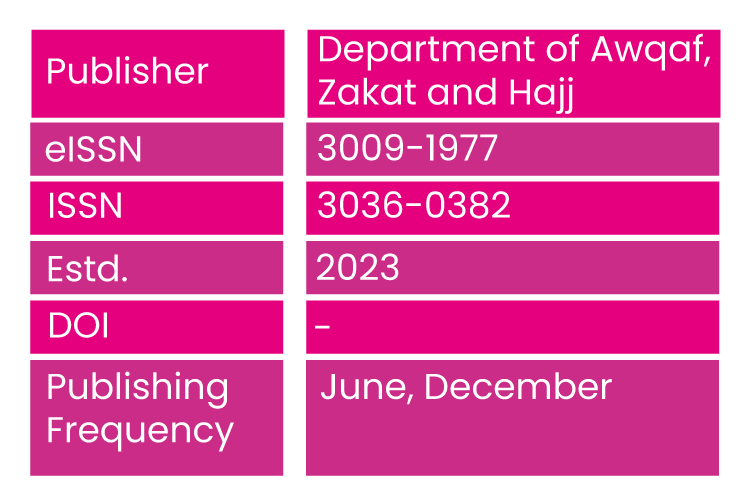
The Journal of Awqaf, Zakat, and Hajj (Jawhar) is registered in MyJurnal, an online system by the Citation and Infometric Division, the Higher Education Department, MoHE. MyJurnal indexes Malaysian journals and provides bibliographic data and full-text articles across various disciplines, including Arts & Humanities, Engineering & Technology, Medical & Health Sciences, Sciences and Social Sciences.